
(Upload on May 27 2026) [ 日本語 | English ]
Mount Usu / Sarobetsu post-mined peatland
From left: Crater basin in 1986 and 2006. Cottongrass / Daylily
HOME > Lecture catalog / Research summary > Glossary > Hydrology
[ water cycle | soil ]
|
The science which deals with the water of the earth, their occurrence, circulation and distribution on the planet, their physical and chemical properties and their interactions with the physical and biological environment, including their responses to human activity (UNESCO 1964) Surface water hydrology (hydrogeology): examines water stored and moving in soils, sediments, and aquifers Marine/ocean hydrology: hydrologic processes in oceans and coastal systems (distinct from oceanography, which is broader) Hydrometeorology: interface between meteorology and hydrology Ecohydrology: interactions between water and ecosystems Water quality hydrology: study of pollutants, nutrients, sediments, and solutes in rivers and lakes Watershed management (drainage basin management): applied hydrology focused on reservoirs, flood protection and basin-scale planning |
|
|
Def. the study of how water moves through a watershed, that is; an area of land where all precipitation drains to a common outlet such as a river, lake, reservoir, bay or ocean Def. Watershed (= drainage basin, catchment, 流域/集水域) (USGS): a land area that drains all rainfall and streams to a single outlet Def. Hydrologic processes (水文過程): precipitation, evaporation, transpiration, soil moisture, groundwater recharge/discharge and streamflow Def. Water budget (水収支) Ex. streamflow ≈ precipitation − evapotranspiration ± changes in soil/groundwater storage Def. Topographic control (地形的支配): watershed boundaries are defined by ridgelines and divides that determine where water flows Horton, Robert E (1875-1945), US, geologist, pedologist 1945 (the year of his death) proposed Horton stream order
main stem = highest order (subjective decision - problematic) Law of stream numbers (流路数の法則): higher‑order streams become progressively fewer, following a geometric decline
Nω ∝ Rb-ω
Nω: number of streams of order ω |
Law of stream lengths (流路長の法則): higher‑order streams are systematically longer, following geometric growth
Lω ∝ Rlω
Lω: average length of streams of order ω Law of basin areas (流域面積の法則): the drainage area associated with each stream order increases geometrically
Aω ∝ Raω
Aω: basin area draining to streams of order ω 1952, 1957: revised Horton method
stream order is determined solely by confluence structure |
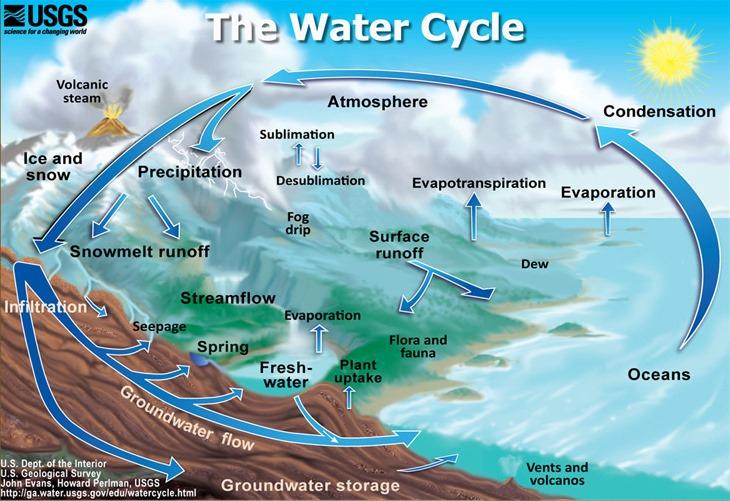 Water in the earth is always in movement, and the natural water cycle, also known as the hydrologic cycle, describes the continuous movement of water on, above, and below the surface of the Earth. Water is always changing states between liquid, vapor, and ice, with these processes happening in the blink of an eye and over millions of years. |
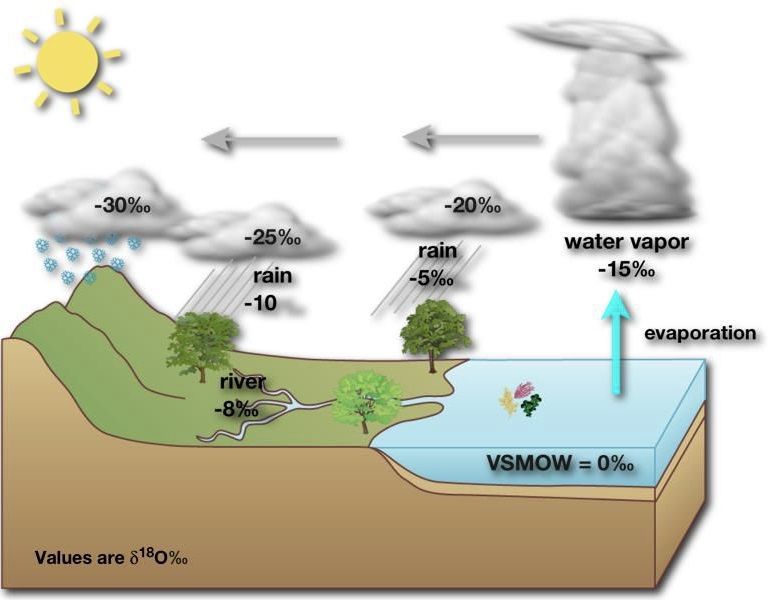 H and O tracers of the hydrologic cycle |
|
= water economy, and water balance General equation ΔS = P - R - G - E - T
ΔS: storage = P - (b - a)
a: amount of remaining water for dt or Δt = P - ΔS if ΔS = b - a |
Water balance in streamIdealP = R + E + T + G Practical P = R + E + T + G + ΔS ΔS: changes (increase or decrease) in water storage at a given time unit for the observation of runoff and/or precipitation in a watershed ΔS ≈ 0: possibly approximate when the unit of period is a year for treating the data
G ≈ 0: possibly apporximate for small watershed |
|
Def. a branch of mechanics that deals with the behavior of materials and fluids that are considered to be continuous, rather than discrete Two main subjects Continuum mechanics (連続体力学, s.s.): mechanical behavior of solid materials |
Sub-subject Solid Mechanics (固体力学): studies how solid materials deform, move, and fail under forces, temperature changes and other external or internal influences Fluid dynamics (流体力学): the behavior of fluids (liquids and gases) in motion Rheology (レオロジー): how materials flow and deform under applied forces |
| Foundation to understand climatology and hydrology |
Magnus effect (マグナス効果): Magnus, Heinrich G (1802-1870) an observable phenomenon commonly associated with a spinning object moving through a fluid, including air applied to ball sports Def. Magnus force, FA = Δp·A = cA·ρ/2(u12 - u22)·A
cA: a scalar dependent on the rotating object |